
Introduction
Hello Dear Readers,
My first feature length script is currently making the rounds at various film festivals. Schisma is a retro-futuristic sci-fi horror about identity, transformation, and trust under extreme isolation.
Logline
In a future militaristic, patriarchal, theocratic society, a gender non-conforming astronaut leads a fractured crew to investigate a mysterious deep space anomaly – one that toys with their fears and mutates each of them, forcing humanity towards a new equilibrium.
Synopsis
Two military officials, monitoring a deep space anomaly, choose the crew of Nova II based upon psychological profiles. Casey Adler – an independent, strong-willed, gender non-conforming astronaut – is chosen to lead a year-long expedition towards the anomaly. Deke Rasmussen is a priest – a narrow minded zealot with a dark past. His dark past is shared by mechanic Mads Trager, a gruff bully whose machismo thinly masks deep seated insecurities. Disabled scrubber technician Flick Jepson is haunted by his past. Gideon and Selene Vale – both psychologists with a hidden agenda – are on board to observe and report on how the crew reacts to the anomaly … and to each other.
Upon encountering the anomaly, purple waves of inexplicable power surround Nova II. The crew fractures – plagued with headaches, hallucinations, and nightmares. Tensions flare, violence erupts, and the Vales secretly record it all. The Vales, still hoping they have some sense of humanity towards their experimental subjects, discover that each crew member is merely a source of data. The Vales learn that another anomaly is forming in the solar system, threatening Earth, making their mission imperative. Rushing to act, Casey goes on a dangerous solo voyage towards the anomaly. Its purple energy draws Casey in; its black heart swallows them whole.
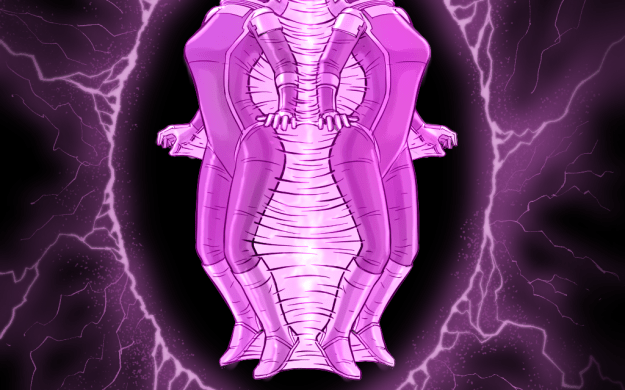
When Casey returns to Nova II, a series of gruesome transformations occur. Casey splits into two seemingly unstoppable alien life forms – Adler One and Two. Selene and Gideon Vale combine into an androgynous person. The anomaly judges Deke, Mads, and Flick for their past deeds. The androgynous person, Adler One and Two at their side, guides Nova II towards a new equilibrium.
Schisma is a story of transformation. It is dictated by the universe. Fighting it is futile. Embracing it is freedom. Everything must move towards equilibrium… whether the human race is ready or not.
Some of the Themes Explored Include:
-
Identity vs. transformation – Is change survival or corruption?
-
Authority & distrust – Who deserves to lead when everyone has secrets?
-
Isolation & paranoia – How far can human relationships fracture before the mission — or the people — fall apart?
-
The significance of religion in the face of an uncaring cosmos
-
Religion as conformity
-
Intense observation causing the subject to change
-
Scientific reason vs. the unknown
-
The perseverance of individuality in the face of societal pressure
What Sets it Apart:
-
A haunting aesthetic that evokes industrial futurism rather than sleek space operas.
-
Exploration of identity, transformation, and isolation, focusing on internal stakes as much as external threat.
-
Highly visual, cinematic sequences—zero-G rescues, hallucination-drenched corridors, and a pulsing, living anomaly.
What Makes Casey a Uniquely Original Protagonist?
Casey Adler is:
-
gender-nonconforming without being defined by that
-
a serious protagonist, not a side character
-
central to a cosmic-horror metamorphosis
-
dealing with identity, embodiment, perception, not queer romance tropes
-
portrayed in a matter-of-fact, non-sensational way
-
surrounded by a Spartan, patriarchal culture, amplifying tension
-
a character with professional competence (pilot, rescuer)
-
whose “difference” foreshadows the anomaly’s psychological effects
-
visually coded androgynous, narratively coded emotionally blocked, thematically coded “between states”
There has not been a protagonist like this in cinema.
Origins
Schisma was born from my lifelong fascination with the space where the scientific and the surreal collide — where logic dissolves and something uncanny, emotional, or cosmic seeps through. Influenced heavily by the duality and dreamlike dread of Mulholland Drive, the script embraces Lynchian ambiguity while grounding itself in hard science, psychology, and body horror.
As an autistic writer, I’ve spent much of my life observing society from its edges, analyzing its systems like ecosystems – truly the “man who fell to Earth”. My transgender brother and I often talk about the childhood we shared: a conservative community that treated difference as threat; bullying that tried to crush anything atypical; adults who confused rigidity with virtue. Those conversations — about fear, resilience, and how trauma shapes identity — strongly informed Schisma.
Casey Adler embodies that tension: discipline versus identity, survival versus selfhood, human order versus something far older. Surrounding Casey is a crew carrying their own wounds, all confronted by an anomaly that sees them more clearly than they see themselves.
At its core, Schisma is about transformation — identity, body, and consciousness.
Transformation is inevitable; the universe demands it.
Resisting is fatal.
Embracing it is freedom.
I write from a neurodivergent perspective, blending grounded science with dream logic and cosmic unease. My work juxtaposes the mundane with the extraordinary. Schisma is my attempt to bring something personal, surreal, and psychologically raw to the cosmic-horror tradition.
Selected Praise
“Your work stood out for its creativity, vision, and alignment with the spirit of our festival.” — Los Angeles Fantasia Fest
Awards & Recognition
• Finalist – The Dunwich Horror Fest (2025)
• Semifinalist – International Indie Film & Screenplay Festival (2025/26)
• Official Selection – Los Angeles Fantasy Fest (2025)
• Official Selection – Blockbuster Screenwriting Contest (2025)
• Ranked #2 out of 109 submissions at Austin After Dark Film Festival (Score: 90/100)
Closing Remarks
I greatly enjoyed writing this script. I love that feeling of burning desire – inspiration at an apex. I simply had to do it; rarely did I step away from it. Initial work took about two months to complete. I wrote it using Word, so the ideas could flow. I then pasted it into Fade In to format it.
The script was sent to three script doctors, to ensure it met industry standards. It was a real learning curve for me. But my attention to detail – combined with my vivid imagination – made for a compelling script.
Like much of my writing, Schisma blends visceral atmosphere, psychological depth, surrealism, and speculative imagination. It explores identity, transformation, and belonging through unconventional lenses.
As always, my work reflects a commitment to bold, character-driven storytelling that challenges boundaries and centres around underrepresented voices.
I plan to submit Schisma to several festivals, hopefully gathering some credentials, then submit it to Black List with an aim to find an agent. Who knows – maybe one day you will see it on the big screen!
 Trapped on a rock floating in space